
Unveiling the Hidden Gems of Nusa Tenggara: Indonesia’s Secret Paradise Beyond Bali
Table of Contents
- Where Is Nusa Tenggara?
- Why Travelers Are Looking Beyond Bali
- Nusa Tenggara and the Global Shift Toward Experiential Travel
- The Geography of Nusa Tenggara
- Best Time to Visit Nusa Tenggara
- Lombok — Bali’s Wilder Neighbor
- Sumba — Indonesia’s Wild Luxury Island
- Alor — Indonesia’s Remote Diving Frontier
- Rote Island — Indonesia’s Southern Edge
- Komodo Dragons — The Last Ancient Predators
- Diving and Snorkeling Across Nusa Tenggara
- The Gili Islands for Beginner Divers
- Flores Overland Journeys — One of Southeast Asia’s Greatest Road Trips
- Hidden Beaches and Lesser-Known Islands
- The Emotional Psychology of Island Hopping
- Luxury Travel Evolution in Eastern Indonesia
- Marine Conservation and Environmental Challenges
- Why Nusa Tenggara Feels More Authentic Than Many Tropical Destinations
- The Reality of Traveling in Remote Indonesia
- Photography and Visual Storytelling in Nusa Tenggara
- Building the Ultimate Nusa Tenggara Itinerary
- Which Nusa Tenggara Island Is Right for You?
- The Rise of Labuan Bajo as a Global Tourism Hub
- The Phinisi Experience — Indonesia’s Most Iconic Sailing Journey
- Luxury Wellness and Retreat Culture
- Surf Culture and Coastal Freedom
- The Future of Tourism in Eastern Indonesia
- Why Nusa Tenggara Represents “The New Indonesia”
- How to Travel Across Nusa Tenggara
- How Expensive Is Nusa Tenggara?
- Frequently Asked Questions About Nusa Tenggara
- Final Conclusion — Why Nusa Tenggara Belongs on Every Serious Traveler’s Radar
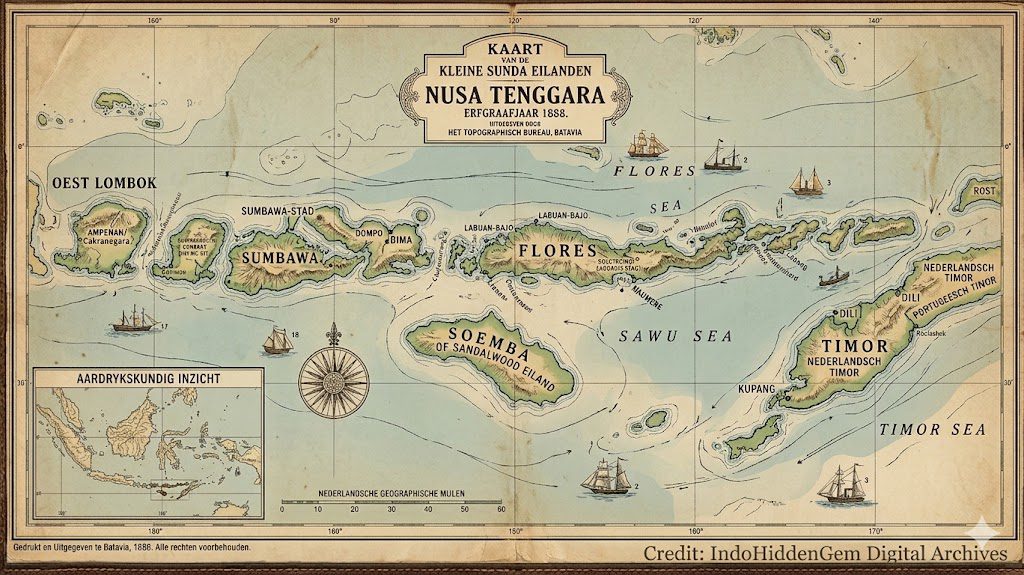
A rare cartographic reconstruction of the Nusa Tenggara archipelago as it appeared in 1888. Reproduced by IndoHiddenGem Digital Archives.
Nusa Tenggara — Indonesia’s Wild Island Frontier Beyond Bali
Bali made Indonesia famous.
But beyond Bali lies a different Indonesia entirely —
wilder, quieter, more cinematic, and infinitely less predictable.
Here, travelers cross volcanic seas instead of traffic jams.
Villages still exist beyond tourism algorithms.
And some islands remain emotionally more powerful precisely because they feel unfinished.
Nusa Tenggara is not a single destination.
It is a chain of experiences spread across remote islands, surf coastlines, volcanic mountains, tribal cultures, luxury eco-retreats, and some of Southeast Asia’s richest marine environments.
For travelers searching beyond overtourism, this region has quietly become one of Indonesia’s most unforgettable frontiers.
Quick Facts About Nusa Tenggara
- Location: Eastern Indonesia
- Provinces: West Nusa Tenggara (NTB) & East Nusa Tenggara (NTT)
- Best Time to Visit: May–October
- Famous For: Komodo dragons, diving, surfing, volcanoes, luxury eco-retreats
- Ideal Trip Length: 10–21 days
- Best For: Adventure travel, photography, island hopping, luxury escape, diving
- Main Gateways: Lombok, Labuan Bajo, Kupang, Tambolaka
- Travel Style: Slow travel and multi-island exploration
For decades, Bali dominated global perceptions of Indonesia.
But beyond Bali lies a chain of islands that many experienced travelers now consider even more emotionally powerful:
Nusa Tenggara.
Stretching across eastern Indonesia, Nusa Tenggara is a region of:
- volcanic islands,
- world-class diving,
- hidden beaches,
- cinematic landscapes,
- traditional villages,
- luxury eco-retreats,
- and remote maritime adventures.
Unlike destinations overwhelmed by mass tourism, much of Nusa Tenggara still feels raw, expansive, and deeply connected to local geography.
Travel here feels different.
The roads are longer.
The islands feel larger.
The sea becomes part of everyday movement.
And landscapes still dominate the experience more than tourism infrastructure itself.
For European and American travelers increasingly searching for:
- authenticity,
- slow travel,
- adventure,
- and meaningful tropical escape,
Nusa Tenggara has quietly become one of Southeast Asia’s most compelling regions.
This is not simply a destination.
It is a journey across some of Indonesia’s last great island frontiers.
Where Is Nusa Tenggara?
Nusa Tenggara is a vast island chain located east of Bali within the Indonesian archipelago.
The region is generally divided into two provinces:
- West Nusa Tenggara (NTB)
- East Nusa Tenggara (NTT)
Major destinations include:
- Lombok,
- the Gili Islands,
- Sumbawa,
- Flores,
- Komodo,
- Sumba,
- Alor,
- Rote,
- and Timor.
Although these islands are geographically connected, each possesses a completely different atmosphere.
Some islands are known for:
- volcano trekking,
- surfing,
- and marine adventure.
Others are famous for:
- tribal culture,
- eco-luxury,
- diving,
- or overland road trips.
Together, they form one of the most diverse travel regions in Southeast Asia.
Why Travelers Are Looking Beyond Bali
Modern travelers increasingly search for destinations that feel:
- less crowded,
- less commercialized,
- and more emotionally immersive.
This global shift explains why Nusa Tenggara has gained growing international attention.
Many repeat Bali visitors eventually begin looking eastward for:
- quieter beaches,
- stronger landscapes,
- more authentic cultural experiences,
- and lower-density tourism.
Nusa Tenggara provides exactly that.
The region still contains:
- empty coastlines,
- remote islands,
- long overland journeys,
- and villages where tourism has not fully replaced local identity.
This creates stronger emotional connection between travelers and environment.
Nature still feels dominant here.
The Rise of “Indonesia Beyond Bali”
“Indonesia Beyond Bali” has become one of the most important narratives in modern Indonesian tourism.
Travelers increasingly realize that Indonesia is not defined by one island alone.
Nusa Tenggara reveals a much broader version of the country:
- maritime cultures,
- volcanic geography,
- dry tropical landscapes,
- traditional communities,
- and frontier-style island exploration.
This shift matters because modern tourism increasingly values:
- uniqueness,
- authenticity,
- and emotional memory over convenience alone.
Nusa Tenggara delivers those experiences exceptionally well.
Nusa Tenggara and the Global Shift Toward Experiential Travel
Global tourism trends increasingly show that travelers are prioritizing experiences over convenience.
Rather than searching only for luxury infrastructure or famous landmarks, many modern travelers now seek:
- emotional connection,
- environmental immersion,
- slower travel rhythms,
- and culturally grounded experiences.
This shift has helped destinations like Nusa Tenggara gain international attention.
The region aligns naturally with several major travel movements including:
- eco-tourism,
- remote luxury,
- marine exploration,
- adventure travel,
- and digital detox tourism.
In many ways, Nusa Tenggara represents the opposite of high-density tourism.
The islands reward patience rather than speed.
And for many travelers, that emotional difference becomes the most memorable part of the journey.
The Geography of Nusa Tenggara
One reason the region feels so powerful is its geographical diversity.
Unlike lush tropical imagery associated with much of Southeast Asia, large parts of Nusa Tenggara are defined by:
- dry savannah hills,
- volcanic ridges,
- rugged coastlines,
- and enormous open skies.
The climate is generally drier than Bali, creating:
- sharper visibility,
- dramatic golden-hour lighting,
- and more cinematic landscapes.
This environmental contrast gives the region unusually strong visual identity.
Photographers and filmmakers are especially drawn to Nusa Tenggara because the islands feel visually coherent yet emotionally varied.
Best Time to Visit Nusa Tenggara
Unlike much of tropical Southeast Asia, Nusa Tenggara experiences a noticeably dry climate across many islands. This creates dramatic seasonal changes that significantly affect travel experiences.
For most international travelers, the best time to visit Nusa Tenggara is during the dry season between May and October.
During these months, travelers can expect:
- clearer skies,
- calmer seas,
- better visibility for diving,
- more reliable island crossings,
- and ideal conditions for road trips and outdoor exploration.
The dry season is especially beautiful in islands such as:
- Sumba,
- Komodo,
- Flores,
- and Rote,
where landscapes transform into golden savannah scenery beneath dramatic tropical light.
Photographers often consider July through September the most visually striking period because visibility becomes exceptionally sharp.
However, each season creates different advantages.
The wet season between November and March brings:
- greener hills,
- fewer tourists,
- lower accommodation prices,
- and quieter travel conditions.
Some remote boat routes may become less predictable during heavy rain periods, especially in eastern islands with rougher sea conditions.
Travelers planning diving expeditions or multi-island sailing journeys should monitor weather carefully and allow flexibility within itineraries.
Ultimately, the best season depends on travel style:
- Dry season favors adventure, sailing, trekking, and diving.
- Wet season favors slower travel, photography, and lower-density tourism.
One of Nusa Tenggara’s greatest strengths is that the region remains emotionally powerful throughout the year.
Volcanoes, Oceans, and Isolation
Geography shapes nearly every aspect of travel here.
Volcanoes dominate skylines across several islands.
Ocean crossings remain central to movement between destinations.
And physical isolation still influences local culture and atmosphere.
Travelers often spend:
- hours crossing seas,
- long days driving mountain roads,
- or nights aboard traditional phinisi boats.
This movement becomes part of the experience itself.
Unlike highly urbanized tourism destinations, Nusa Tenggara still allows travelers to feel geographical distance.
That sense of scale creates stronger emotional impact.
Lombok — Bali’s Wilder Neighbor
Lombok is often the first step into Nusa Tenggara for international travelers.
Located directly east of Bali, the island offers:
- quieter beaches,
- stronger mountain landscapes,
- surf culture,
- waterfalls,
- and lower-density tourism.
Compared with Bali, Lombok feels:
- calmer,
- more spacious,
- and less commercially intense.
This difference becomes immediately noticeable.
Travelers encounter:
- open roads,
- dramatic coastlines,
- and Mount Rinjani towering above the island landscape.
Tourism exists here, but nature still feels dominant.
Mount Rinjani — Indonesia’s Legendary Volcano Trek
Mount Rinjani is one of Southeast Asia’s most respected trekking destinations.
The volcano rises above Lombok at over 3,700 meters and offers:
- crater lakes,
- volcanic landscapes,
- sunrise viewpoints,
- and physically demanding multi-day hikes.
The trek is challenging but deeply rewarding.
At sunrise near the crater rim, trekkers witness:
- volcanic smoke drifting through valleys,
- mountain silhouettes emerging through clouds,
- and enormous panoramic views across Lombok and neighboring islands.
Unlike heavily commercialized mountain tourism elsewhere in Asia, Rinjani still feels raw and physically real.
That authenticity makes the experience emotionally powerful.
South Lombok and Surf Culture
Southern Lombok has developed one of Indonesia’s strongest surf and beach cultures outside Bali.
The landscape here feels cinematic:
- dry rolling hills,
- white-sand beaches,
- turquoise bays,
- and winding coastal roads.
Surf towns such as Kuta Lombok now attract:
- surfers,
- photographers,
- digital nomads,
- and luxury travelers seeking quieter alternatives to Bali.
Despite rapid growth, the region still retains significant openness and environmental beauty.
The Gili Islands — Tropical Simplicity
Off Lombok’s northwest coast lie the Gili Islands:
- Gili Trawangan,
- Gili Air,
- and Gili Meno.
These islands remain popular because they preserve a simple formula:
- no cars,
- no motorbikes,
- beach access everywhere,
- snorkeling reefs,
- and relaxed island rhythm.
Each island has distinct personality.
Gili Trawangan offers:
- social nightlife,
- diving schools,
- and backpacker culture.
Gili Air provides:
- balance,
- calm atmosphere,
- and strong long-stay appeal.
Gili Meno feels:
- quieter,
- romantic,
- and more isolated.
Together, the islands offer one of Southeast Asia’s most accessible tropical escape experiences.
Diving and Marine Life
The waters surrounding Lombok and the Gilis support:
- sea turtles,
- coral reefs,
- tropical fish,
- and beginner-friendly diving conditions.
Many travelers complete their first scuba certifications here before exploring more advanced Indonesian dive destinations later.
The marine environment plays a major role in the region’s emotional identity.
Life slows down naturally around the ocean.
Sumba — Indonesia’s Wild Luxury Island
Among all the islands in Nusa Tenggara, Sumba has developed one of the most distinctive reputations among international travelers. While Bali dominates mainstream tourism and Komodo dominates adventure headlines, Sumba occupies a different category entirely. It has become associated with quiet luxury, cinematic landscapes, traditional culture, and remote exclusivity.
Yet what makes Sumba truly powerful is not luxury alone.
It is the feeling that the island still belongs to itself.
Travelers arriving in Sumba quickly notice the difference. The roads are quieter. The beaches feel emptier. The hills stretch endlessly beneath enormous skies. Villages remain active parts of local life rather than staged tourism environments. Compared with more commercialized island destinations, Sumba feels emotionally spacious.
That sense of openness has become increasingly valuable in global tourism.
Modern travelers — particularly from Europe and North America — are increasingly searching for destinations that feel restorative rather than overstimulating. Sumba fits this trend perfectly because the island encourages stillness instead of constant activity.
The landscape itself contributes strongly to that atmosphere.
Unlike the dense tropical imagery associated with much of Indonesia, Sumba is visually defined by:
- rolling savannah hills,
- dry grasslands,
- dramatic cliffs,
- winding coastal roads,
- seasonal waterfalls,
- remote beaches,
- and scattered traditional villages.
During the dry season, large parts of the island turn golden, creating scenery that feels almost African in character. Horses move across open fields while distant coastlines shimmer beneath harsh tropical light. The result feels cinematic and unusually photogenic.
For photographers, filmmakers, surfers, honeymooners, and luxury travelers, Sumba has become one of Indonesia’s most compelling destinations.
But unlike destinations that lose their soul under tourism pressure, Sumba still retains a strong sense of cultural gravity.
That balance is rare.
Some destinations impress travelers immediately.
Sumba works differently.
It slowly reveals itself through silence, distance, and atmosphere.
The Rise of Quiet Luxury in Sumba
One reason Sumba has become increasingly visible internationally is the rise of “quiet luxury” travel.
Rather than emphasizing nightlife, shopping, or social status, quiet luxury focuses on:
- privacy,
- atmosphere,
- landscape,
- emotional experience,
- sustainability,
- and architectural integration with nature.
Sumba embodies this style naturally.
Luxury resorts here are not designed around urban glamour. Instead, they emphasize:
- open-air design,
- local materials,
- ocean views,
- horseback riding,
- wellness,
- surfing,
- village experiences,
- and environmental immersion.
The island’s remoteness becomes part of the appeal rather than a disadvantage.
For wealthy travelers burned out by crowded luxury destinations, Sumba offers emotional exclusivity rather than performative exclusivity.
That distinction matters.
Modern affluent travelers increasingly value silence, authenticity, and privacy more than visible extravagance. Sumba delivers those elements exceptionally well.
Nihiwatu and the Global Attention on Sumba
One of the major turning points for Sumba tourism came through the international recognition of Nihiwatu, now widely considered among the world’s top remote luxury resorts.
The resort gained global attention because it successfully combined:
- sustainability,
- architecture,
- surf culture,
- social impact,
- and environmental immersion.
Unlike isolated luxury compounds that feel disconnected from their surroundings, the best resorts in Sumba attempt to integrate with the island’s geography and cultural identity.
Experiences often include:
- private beach horseback riding,
- waterfall expeditions,
- surf access,
- local weaving workshops,
- village visits,
- and wellness retreats overlooking the Indian Ocean.
This creates a travel experience that feels emotionally textured rather than merely comfortable.
Importantly, Sumba remains accessible beyond ultra-premium tourism.
Backpackers, photographers, road trippers, and independent travelers can still explore much of the island through:
- guesthouses,
- eco-lodges,
- local drivers,
- motorcycle rentals,
- and small family-run accommodations.
That accessibility gives Sumba a broader emotional range than destinations existing only for luxury tourism.
Traditional Villages and Marapu Culture
One of Sumba’s strongest dimensions is its cultural identity.
The island remains deeply connected to Marapu traditions — an ancestral belief system that continues to influence local customs, ceremonies, architecture, and social structure.
Travelers exploring the island encounter villages with:
- towering peaked roofs,
- megalithic stone tombs,
- ceremonial spaces,
- and traditional houses designed around ancestral lineage.
These villages are not recreated tourist attractions.
They remain living communities.
That distinction creates a much deeper travel experience because visitors are not observing frozen history. They are encountering continuity.
Villages such as:
- Ratenggaro,
- Praijing,
- Wainyapu,
- and Tarung
have become known for their architecture and cultural atmosphere, yet respectful behavior remains essential.
Travelers should:
- ask permission before photographing individuals,
- dress respectfully,
- avoid intrusive drone use,
- support local guides,
- and remember that these are homes before they are attractions.
The best experiences emerge through patience and humility rather than aggressive tourism behavior.
For culturally curious travelers, Sumba offers something increasingly rare in modern travel:
a destination where tradition still visibly shapes daily life.
Weekuri Lagoon and Sumba’s Natural Landscapes
Weekuri Lagoon is among Sumba’s best-known natural attractions.
The lagoon’s enclosed saltwater basin creates striking turquoise water framed by limestone formations and dry tropical terrain. During strong sunlight, the colors become intensely vivid.
Yet focusing only on Weekuri misses the larger point of Sumba.
The island’s power comes from continuity of landscape.
Driving across Sumba reveals:
- empty beaches,
- dramatic clifflines,
- open grasslands,
- isolated roads,
- seasonal rivers,
- hidden waterfalls,
- and panoramic coastal views.
Unlike destinations dependent on a few famous landmarks, Sumba works as a full atmospheric journey.
The road itself becomes part of the attraction.
Travelers often remember:
- changing weather,
- roadside horses,
- children waving from villages,
- long empty coastlines,
- and golden afternoon light
as strongly as any specific attraction.
This is one reason Sumba resonates so deeply with photographers and filmmakers.
The island feels visually coherent.
Everything belongs to the same emotional landscape.
Alor — Indonesia’s Remote Diving Frontier
While Komodo receives most international diving attention in Nusa Tenggara, experienced divers often speak quietly about another destination with enormous marine potential:
Alor.
Located in eastern Indonesia, Alor remains far less commercialized than mainstream dive regions. That relative isolation has helped preserve both marine biodiversity and a stronger sense of exploration.
For serious divers, Alor represents frontier diving.
The reefs feel healthier.
The crowds are smaller.
The experience feels more intimate.
Unlike heavily trafficked marine destinations, many dive sites here still retain the feeling of discovery.
Why Divers Love Alor
Alor sits within the Coral Triangle, one of the richest marine ecosystems on Earth.
The underwater conditions support:
- coral walls,
- volcanic underwater terrain,
- macro biodiversity,
- pelagic species,
- and exceptional reef systems.
Divers may encounter:
- hammerhead sharks,
- reef sharks,
- eagle rays,
- pygmy seahorses,
- sea snakes,
- giant trevallies,
- and large schools of fish.
Visibility can be spectacular during favorable conditions.
At the same time, Alor is not always beginner friendly.
Currents may be strong.
Water temperatures can vary.
Sites may require experience.
That challenge is precisely what attracts advanced divers searching for richer underwater environments beyond mass tourism.
The diving here feels alive rather than curated.
The Emotional Difference Between Komodo and Alor
Komodo and Alor are both exceptional marine destinations, but they create very different emotional experiences.
Komodo feels dramatic and iconic.
Alor feels remote and exploratory.
Komodo offers:
- famous landscapes,
- luxury boats,
- iconic viewpoints,
- and broader tourism infrastructure.
Alor offers:
- intimacy,
- silence,
- smaller dive operations,
- and a stronger sense of isolation.
Travelers seeking polished adventure often choose Komodo.
Travelers seeking frontier exploration often prefer Alor.
Neither is objectively better.
They simply appeal to different personalities.
Alor Beyond Diving
Although diving dominates Alor’s international reputation, the islands also possess significant cultural depth.
Travelers encounter:
- traditional weaving communities,
- volcanic coastlines,
- fishing villages,
- mountainous interiors,
- and distinct local identities.
Tourism remains relatively limited outside marine travel, allowing visitors to experience a more grounded side of eastern Indonesia.
For travelers tired of overdeveloped tourism environments, this authenticity becomes extremely valuable.
Rote Island — Indonesia’s Southern Edge
Rote Island occupies a unique psychological space in Indonesia travel.
As the country’s southernmost inhabited island, Rote feels distant even within Nusa Tenggara itself.
The island is best known internationally among surfers because of the famous T-Land wave, considered one of Indonesia’s premier left-hand surf breaks.
Yet Rote offers much more than surf culture.
The island’s atmosphere is deeply calming.
Travelers find:
- crystal lagoons,
- palm-lined beaches,
- fishing villages,
- empty coastlines,
- and extremely slow rhythms of life.
Compared with Bali’s busy surf scene, Rote feels almost meditative.
Why Rote Appeals to Slow Travelers
Rote lacks the stimulation overload common in mainstream tourism destinations.
There are:
- fewer crowds,
- fewer beach clubs,
- fewer nightlife scenes,
- and fewer large-scale developments.
Instead, travelers settle into simpler routines:
- swimming,
- reading,
- surfing,
- photography,
- conversations with locals,
- and watching changing ocean conditions.
For many visitors, the island becomes emotionally restorative.
This is especially attractive to travelers seeking recovery from hyper-connected urban life.
Rote does not try to entertain aggressively.
It simply allows space.
Diving and Snorkeling Across Nusa Tenggara
Nusa Tenggara is one of the strongest marine travel regions in Southeast Asia.
Because the islands sit within the Coral Triangle, the underwater biodiversity is extraordinary.
The region supports:
- coral reefs,
- manta rays,
- turtles,
- sharks,
- macro marine life,
- and seasonal whale migration routes.
Importantly, the marine experiences vary significantly between islands.
That diversity allows travelers to choose environments matching their skill level and travel style.
Komodo Dragons — The Last Ancient Predators
Komodo National Park is home to the world’s largest living lizard:
the Komodo dragon.
These prehistoric reptiles can grow over three meters long and remain one of Indonesia’s most extraordinary wildlife experiences.
Travelers typically encounter Komodo dragons on islands such as:
- Komodo Island,
- Rinca Island,
- and parts of Padar National Park zones.
Guided ranger treks remain mandatory because the animals are powerful apex predators despite their often slow appearance.
Yet beyond the dragons themselves, the surrounding landscapes contribute equally to the experience.
Dry savannah hills, volcanic coastlines, and turquoise waters create one of the most visually recognizable environments in Southeast Asia.
This combination of wildlife and scenery is one reason Komodo has become globally iconic.
Komodo Diving
Komodo remains the region’s most internationally recognized diving destination.
The strong currents flowing between islands create nutrient-rich ecosystems capable of supporting large marine populations.
Divers frequently encounter:
- manta rays,
- reef sharks,
- barracudas,
- giant trevallies,
- napoleon wrasse,
- and dense reef life.
The diving can feel world-class.
However, Komodo is not ideal for everyone.
Strong currents require:
- experienced operators,
- realistic self-assessment,
- and careful safety procedures.
Travelers should choose dive centers carefully and communicate honestly about experience level.
The Gili Islands for Beginner Divers
While Komodo appeals strongly to experienced divers, the Gili Islands provide one of Indonesia’s best beginner-friendly marine environments.
Conditions are generally calmer.
Visibility is often excellent.
Sea turtles are common.
Many travelers complete their first dive certifications here before moving on to more advanced locations elsewhere in Indonesia.
This accessibility makes the Gilis an important gateway into Indonesian diving culture.
Snorkeling Culture in Nusa Tenggara
Even travelers who never scuba dive can still experience exceptional marine life throughout the region.
Popular snorkeling experiences include:
- turtle encounters,
- shallow coral gardens,
- reef fish,
- drift snorkeling,
- and clear tropical lagoons.
However, travelers should never underestimate ocean conditions.
Even visually calm locations may contain:
- currents,
- sharp coral,
- sudden weather changes,
- or boat traffic.
Using reputable local guides remains important.
Food, Coffee, and Everyday Life
Food in Nusa Tenggara often feels simpler than the culinary scenes of Bali or Jakarta.
Yet simplicity here becomes part of the authenticity.
Meals commonly revolve around:
- fresh seafood,
- grilled fish,
- sambal,
- rice,
- coconut,
- vegetables,
- tropical fruit,
- and local spices.
Rather than highly stylized dining experiences, travelers often encounter food through:
- roadside warungs,
- family restaurants,
- fishing communities,
- and local markets.
This creates a stronger connection between food and daily life.
For many travelers, some of the most memorable meals happen unexpectedly in small villages overlooking the sea rather than in luxury restaurants.
Beyond landscapes and adventure, many travelers remember Nusa Tenggara most strongly through human encounters.
Conversations with boat crews, roadside coffee sellers, village families, local guides, and fishermen often become defining emotional memories of the journey.
In many smaller islands, hospitality still feels personal rather than transactional.
Travelers are frequently invited into everyday moments rather than curated tourism performances.
That human warmth creates a different emotional atmosphere from destinations where tourism has become heavily industrialized.
Flores Overland Journeys — One of Southeast Asia’s Greatest Road Trips
Among experienced travelers, Flores has quietly developed a reputation as one of the best overland island journeys in Southeast Asia.
Not because the roads are perfect.
Not because the infrastructure is luxurious.
But because the island constantly changes.
Few destinations sustain visual and emotional momentum across such long distances. On Flores, travelers move through:
- volcanic mountains,
- mist-covered highlands,
- fishing villages,
- jungle valleys,
- Catholic towns,
- rice terraces,
- dramatic coastlines,
- and isolated cultural communities.
The island feels alive in motion.
Unlike destinations built around isolated attractions connected by airports, Flores rewards continuous travel. The transitions themselves become meaningful.
A six-hour drive rarely feels visually repetitive.
That is one reason photographers and documentary filmmakers often become deeply attached to Flores. The island constantly offers changing textures, light conditions, and human activity.
Travel here feels immersive rather than curated.
Labuan Bajo — The Gateway to Komodo
Most international travelers first encounter Flores through Labuan Bajo.
Once a small fishing town, Labuan Bajo has transformed into one of Indonesia’s fastest-growing tourism hubs because of its proximity to Komodo National Park.
Today, travelers find:
- luxury resorts,
- diving centers,
- phinisi operators,
- cafes,
- sunset bars,
- and expanding tourism infrastructure.
Yet despite rapid development, Labuan Bajo still retains access to extraordinary landscapes.
Sunsets overlooking the harbor can feel spectacular, especially as phinisi boats return across glowing water beneath dry volcanic hills.
For many travelers, Labuan Bajo becomes:
- the beginning of Komodo expeditions,
- the starting point for Flores road trips,
- or a transition zone between luxury and adventure.
Its rapid growth also reflects a larger trend in Indonesia tourism:
the movement eastward beyond Bali.
The Reality of Long-Distance Travel in Flores
Travelers planning Flores itineraries often underestimate distances.
Roads may appear manageable on maps, yet mountainous terrain dramatically slows movement.
A route of only 150 kilometers may require:
- five hours,
- seven hours,
- or even longer.
Curving roads, changing weather, road repairs, livestock crossings, and mountain conditions all affect travel times.
At first, this may frustrate travelers accustomed to efficient tourism infrastructure.
But eventually many visitors realize something important:
the slowness is part of Flores’ emotional identity.
The island forces travelers to observe.
You notice:
- roadside coffee stalls,
- changing vegetation,
- local church communities,
- children walking home from school,
- volcanic silhouettes,
- and mountain weather patterns.
The journey itself becomes the destination.
Flores and Catholic Identity
One of the most interesting cultural aspects of Flores is its strong Catholic identity.
Unlike much of Indonesia, which is predominantly Muslim, Flores developed strong Catholic influence during Portuguese colonial periods.
Travelers notice this through:
- churches,
- religious statues,
- local ceremonies,
- and community traditions.
The cultural atmosphere often feels distinct from other Indonesian islands.
This religious history contributes to Flores’ unique identity and creates a fascinating blend between:
- Indonesian traditions,
- local customs,
- and Catholic influences.
For culturally observant travelers, these details add depth to the overland experience.
Kelimutu — Flores’ Sacred Crater Lakes
Among Flores’ most iconic natural landmarks, Kelimutu occupies a unique place both visually and spiritually.
The volcano is famous for its three crater lakes, each capable of changing color over time due to mineral and volcanic activity.
Depending on seasonal and geological conditions, the lakes may appear:
- turquoise,
- black,
- deep blue,
- green,
- or reddish brown.
For local communities, Kelimutu carries strong spiritual significance connected to ancestral belief systems.
Sunrise remains the most powerful time to experience the volcano.
As mist moves across the highlands and changing light touches the crater lakes, the atmosphere can feel surreal and deeply cinematic.
Unlike many heavily commercialized volcanic attractions in Asia, Kelimutu still retains a quieter and more contemplative atmosphere.
For photographers and landscape travelers, it remains one of Indonesia’s most visually distinctive volcanic destinations.
Hidden Beaches and Lesser-Known Islands
Although Komodo dominates international headlines, many of Nusa Tenggara’s most memorable experiences happen far away from famous attractions.
Across the region, travelers encounter beaches that remain:
- unnamed online,
- lightly visited,
- or known mostly by local communities.
This is increasingly rare in global tourism.
In many destinations worldwide, nearly every scenic location has already been heavily commercialized or transformed into social-media infrastructure.
Nusa Tenggara still contains places that feel undiscovered.
That feeling matters emotionally.
Travelers increasingly value destinations where exploration still feels genuine rather than performative.
Hidden Beaches in South Lombok
Southern Lombok contains some of Indonesia’s most underrated beaches.
Many are separated by hills, cliffs, or undeveloped roads, creating natural barriers against mass tourism.
Travelers willing to explore beyond main surf areas often discover:
- empty white-sand coves,
- turquoise bays,
- cliffside viewpoints,
- and beaches with minimal infrastructure.
Unlike Bali’s dense tourism corridors, South Lombok still provides room for solitude.
This openness has become one of the island’s strongest assets.
Secret Coastal Landscapes in Flores
Flores also hides extraordinary coastal scenery outside major tourism routes.
Along overland drives, travelers frequently encounter:
- volcanic beaches,
- black-sand coastlines,
- hidden bays,
- and isolated fishing communities.
Because infrastructure remains limited in many regions, tourism pressure stays relatively low.
This creates a stronger sense of discovery.
Many travelers describe moments in Flores where they stop simply because the landscape suddenly becomes overwhelming.
Not every memorable place has a name.
The Emotional Psychology of Island Hopping
One reason travelers become deeply attached to Nusa Tenggara is the psychological effect of island movement itself.
Island hopping changes the rhythm of travel.
Every crossing creates emotional transition.
Each island feels like entering a slightly different world:
- different landscapes,
- different climates,
- different architecture,
- different marine conditions,
- different food,
- and different cultural rhythms.
That constant reinvention prevents travel fatigue.
In heavily urbanized tourism destinations, travelers often experience repetition after several days.
Nusa Tenggara rarely feels repetitive because geography itself keeps changing.
The sea acts as emotional separation between experiences.
This is one reason longer itineraries across the region often feel richer than short resort-based holidays.
Why Boat Travel Feels Transformative
Boat travel remains central to the emotional identity of Nusa Tenggara.
Whether aboard:
- public ferries,
- fast boats,
- dive liveaboards,
- or luxury phinisi vessels,
travelers spend significant time at sea.
That changes perspective.
Movement becomes slower and more physical.
You feel:
- changing weather,
- ocean currents,
- sunrise conditions,
- and geographical distance.
Modern travel often removes sensory connection through airports and highways.
Maritime travel restores it.
Many travelers later remember the feeling of crossing between islands more strongly than individual attractions themselves.
Luxury Travel Evolution in Eastern Indonesia
Luxury tourism across eastern Indonesia is evolving rapidly.
But unlike urban luxury markets focused on visible consumption, luxury in Nusa Tenggara increasingly revolves around:
- privacy,
- nature,
- sustainability,
- and emotional experience.
This shift aligns with global high-end travel trends.
Affluent travelers today increasingly prioritize:
- wellness,
- immersion,
- remoteness,
- and authenticity.
Nusa Tenggara is exceptionally well positioned for this evolution.
Eco-Luxury and Sustainability
One of the strongest emerging trends in Indonesia tourism is eco-luxury.
Travelers increasingly want high-end experiences that:
- support local communities,
- reduce environmental damage,
- and integrate naturally into landscapes.
In Nusa Tenggara, this often appears through:
- low-density architecture,
- locally sourced materials,
- reef conservation programs,
- community tourism initiatives,
- and regenerative hospitality models.
This approach works particularly well because the region’s natural beauty remains its greatest asset.
Overdevelopment would weaken the very qualities attracting travelers.
The long-term success of eastern Indonesia tourism depends heavily on balance.
Why High-End Travelers Are Moving Beyond Bali
Bali remains globally famous, but many repeat travelers eventually search for destinations with:
- fewer crowds,
- more privacy,
- stronger landscape drama,
- and less commercial saturation.
Nusa Tenggara increasingly fills that role.
For luxury travelers who already experienced:
- Seminyak,
- Canggu,
- Ubud,
- and Uluwatu,
the eastern islands offer something emotionally fresher.
Instead of social visibility, travelers find:
- silence,
- distance,
- and immersion.
This shift is becoming one of the defining patterns of Indonesian luxury tourism.
Adventure Travel in Nusa Tenggara
Beyond luxury, the region also stands among Southeast Asia’s strongest adventure travel zones.
Travelers can combine:
- volcano trekking,
- surfing,
- freediving,
- scuba diving,
- sailing,
- road trips,
- hiking,
- cliff exploration,
- and remote island travel
within a single itinerary.
This diversity gives Nusa Tenggara unusual depth.
Adventure travelers rarely become bored because the environments constantly change.
Surfing Across the Region
Surf culture remains deeply connected to several islands including:
- Lombok,
- Sumbawa,
- and Rote.
The region contains waves suitable for:
- beginners,
- intermediate surfers,
- and advanced riders.
Unlike Bali’s highly crowded surf zones, many breaks across Nusa Tenggara remain less saturated.
This creates a more relaxed surf atmosphere.
For many surfers, the appeal lies not only in wave quality but also in environmental context:
- empty coastlines,
- remote villages,
- and dramatic scenery.
Surfing here often feels more exploratory than commercial.
Trekking Beyond Rinjani
Although Mount Rinjani receives most trekking attention, the region contains many lesser-known hiking opportunities.
Travelers encounter:
- volcanic viewpoints,
- waterfall trails,
- savannah landscapes,
- and remote hill routes across multiple islands.
Flores especially offers excellent opportunities for scenic walking and landscape photography because elevation changes create dramatic visual variety.
The trekking culture here feels less industrialized than in heavily commercial mountain destinations elsewhere in Asia.
Marine Conservation and Environmental Challenges
Despite its beauty, Nusa Tenggara faces significant environmental pressures.
Tourism growth creates challenges involving:
- plastic waste,
- reef damage,
- overfishing,
- water management,
- and infrastructure strain.
Marine ecosystems remain vulnerable.
This is particularly important because the region’s economy increasingly depends on environmental quality.
Travelers can contribute positively by:
- minimizing plastic usage,
- supporting ethical operators,
- avoiding reef contact,
- using reef-safe sunscreen,
- and respecting wildlife guidelines.
Responsible tourism is not optional here.
It is essential for long-term preservation.
Komodo Conservation Reality
Komodo National Park illustrates the tension between tourism growth and conservation.
The park’s global popularity brings:
- funding,
- jobs,
- and international visibility.
But it also creates:
- environmental pressure,
- overcrowding concerns,
- and ecosystem management challenges.
Balancing tourism with ecological protection will remain one of Indonesia’s major sustainability tests in the coming years.
Travelers should choose operators that:
- follow park regulations,
- limit environmental impact,
- and prioritize responsible practices.
Why Nusa Tenggara Feels More Authentic Than Many Tropical Destinations
Travel authenticity is difficult to define, yet many travelers consistently describe Nusa Tenggara as feeling more “real” than heavily commercialized tropical destinations.
Part of this comes from geography.
The region remains physically challenging enough that tourism has not completely reshaped local life.
Communities still function primarily around:
- fishing,
- agriculture,
- religion,
- local trade,
- and regional movement.
Tourism exists, but it has not entirely replaced existing social structures.
This creates a stronger feeling of continuity between travelers and local reality.
You do not feel entirely separated inside tourism infrastructure.
That emotional permeability is increasingly rare.
The Importance of Imperfection
Ironically, some of the region’s imperfections are precisely what preserve its emotional power.
Roads are not always smooth.
Schedules are not always efficient.
Wi-Fi is not always reliable.
Yet these limitations force travelers into a different rhythm.
People become more observant.
More patient.
More present.
Modern luxury tourism often removes unpredictability entirely.
Nusa Tenggara still allows room for surprise.
That unpredictability creates stronger memories.
The Reality of Traveling in Remote Indonesia
Travel in Nusa Tenggara can be deeply rewarding, but it also requires flexibility.
Infrastructure across many islands remains limited compared with Bali or major Southeast Asian tourism hubs.
Travelers may encounter:
- delayed ferries,
- rough roads,
- inconsistent internet,
- changing weather conditions,
- and limited medical facilities in remote areas.
Yet for many experienced travelers, these imperfections are precisely what preserve the region’s authenticity.
The islands still feel shaped more by geography than by tourism systems.
Approaching the journey with patience and adaptability often creates a far richer experience than attempting to control every detail.
Photography and Visual Storytelling in Nusa Tenggara
Few regions in Southeast Asia are as visually diverse as Nusa Tenggara.
Photographers can capture:
- volcanic landscapes,
- cinematic coastlines,
- traditional villages,
- underwater ecosystems,
- mountain fog,
- luxury architecture,
- sailing culture,
- and dramatic dry-season terrain
within relatively connected travel routes.
The region works especially well for:
- drone photography,
- documentary storytelling,
- cinematic travel content,
- luxury branding,
- and adventure campaigns.
This is one reason the islands increasingly appear in:
- travel magazines,
- luxury tourism branding,
- social media campaigns,
- and destination documentaries.
The landscapes possess strong visual identity.
Why the Light Feels Different Here
Photographers often mention the unique quality of light across eastern Indonesia.
The drier climate creates:
- sharper visibility,
- stronger contrast,
- and dramatic golden-hour conditions.
In islands such as Sumba and Komodo, late afternoon light can transform hills and coastlines into almost cinematic environments.
This natural lighting contributes strongly to the emotional impact of photography across the region.
It helps explain why even simple landscapes here often feel visually powerful.
Building the Ultimate Nusa Tenggara Itinerary
One of the biggest mistakes travelers make in Nusa Tenggara is trying to see too much too quickly.
Because the region looks compact on maps, many visitors underestimate:
- travel times,
- weather variability,
- sea conditions,
- road fatigue,
- and the emotional impact of constant movement.
But Nusa Tenggara is not designed for rushed tourism.
The region works best when travelers accept slower pacing and build itineraries around experience quality rather than destination quantity.
That approach dramatically changes the emotional outcome of the journey.
Instead of feeling exhausted by logistics, travelers begin to absorb:
- changing landscapes,
- local routines,
- marine environments,
- and cultural transitions between islands.
The journey becomes layered rather than rushed.
Which Nusa Tenggara Island Is Right for You?
| Island | Best For | Atmosphere |
|---|---|---|
| Lombok | Surfing, beaches, volcano trekking | Relaxed adventure |
| Gili Islands | Snorkeling, beginner diving | Tropical island simplicity |
| Flores | Road trips, culture, Komodo access | Cinematic exploration |
| Sumba | Quiet luxury, photography, wellness | Remote and emotional |
| Alor | Advanced diving | Frontier marine adventure |
| Rote | Surfing and slow travel | Calm and isolated |
| Sumbawa | Experienced surfers | Raw and undeveloped |
7-Day Nusa Tenggara Itinerary
For travelers with limited time, focusing on one core region usually creates the best experience.
A strong 7-day route might include:
Option 1: Lombok + Gili Islands
Ideal for:
- first-time Indonesia travelers,
- couples,
- beginner divers,
- and relaxed beach-focused trips.
Possible experiences:
- South Lombok beaches,
- surf culture,
- Gili snorkeling,
- waterfalls,
- and luxury beach stays.
Option 2: Flores + Komodo
Ideal for:
- photographers,
- adventure travelers,
- divers,
- and island-hopping enthusiasts.
Possible experiences:
- Labuan Bajo,
- Komodo sailing,
- Padar Island,
- phinisi life,
- and Flores overland sections.
Trying to combine too many islands within one week often weakens the experience.
14-Day Ultimate Route
Two weeks allows travelers to experience Nusa Tenggara more deeply.
A balanced route may include:
- Lombok,
- the Gili Islands,
- Flores,
- Komodo,
- and Sumba.
This combination creates strong variation between:
- beaches,
- mountains,
- marine ecosystems,
- cultural villages,
- and luxury landscapes.
Importantly, travelers should still avoid overscheduling.
Leaving room for weather changes and spontaneous discoveries improves the journey significantly.
3-Week Deep Exploration Route
For travelers seeking full immersion, three weeks unlocks the true depth of the region.
Possible routes can include:
- Lombok,
- Sumbawa,
- Komodo,
- Flores overland journeys,
- Alor,
- and Sumba.
At this pace, travelers begin experiencing:
- regional transitions,
- emotional contrasts,
- and the deeper rhythm of eastern Indonesia.
The trip stops feeling like tourism and begins feeling more like temporary migration through landscapes.
That distinction is important.
Longer itineraries create stronger emotional attachment because travelers adapt psychologically to the region’s slower pace.
The Rise of Labuan Bajo as a Global Tourism Hub
Labuan Bajo is currently one of Indonesia’s fastest-growing tourism destinations.
The town’s transformation reflects the broader global discovery of eastern Indonesia.
Only a decade ago, Labuan Bajo was relatively quiet.
Today, it has become:
- a luxury tourism gateway,
- a diving center,
- a sailing hub,
- and one of Indonesia’s most strategic adventure destinations.
This growth has brought:
- better hotels,
- expanded airports,
- international restaurants,
- and premium tourism services.
But it has also introduced pressure.
Rapid tourism development creates risks involving:
- overconstruction,
- environmental degradation,
- waste management,
- and cultural imbalance.
The future of Labuan Bajo depends heavily on sustainable planning.
If managed carefully, the destination could become a model for balanced eco-tourism in Southeast Asia.
If poorly managed, it risks losing the natural atmosphere that made travelers fall in love with it originally.
Why Labuan Bajo Appeals to Luxury Travelers
Labuan Bajo has become especially attractive to luxury travelers because it combines:
- high-end accommodation,
- dramatic landscapes,
- marine adventure,
- and exclusive sailing experiences.
Unlike urban luxury destinations, the luxury here feels tied directly to geography.
Travelers wake up overlooking:
- volcanic islands,
- turquoise bays,
- and phinisi boats crossing open water.
The visual atmosphere itself becomes part of the luxury experience.
This geographic immersion is one reason eastern Indonesia increasingly appeals to premium international tourism markets.
The Phinisi Experience — Indonesia’s Most Iconic Sailing Journey
Few travel experiences in Southeast Asia are as emotionally memorable as multi-day phinisi journeys through Komodo National Park.
Phinisi boats are traditional Indonesian wooden sailing vessels originally associated with Bugis maritime culture.
Today, these boats support:
- adventure expeditions,
- diving trips,
- luxury charters,
- photography journeys,
- and private island-hopping experiences.
The boats themselves often become the emotional center of the trip.
Why Travelers Become Emotionally Attached to Phinisi Life
Modern tourism often isolates travelers from natural rhythms.
Phinisi travel reverses that.
Life onboard becomes synchronized with:
- sunrise,
- tides,
- weather,
- ocean conditions,
- and island geography.
Days unfold differently than hotel-based tourism.
Travelers:
- wake with changing light,
- swim in remote bays,
- eat meals overlooking open sea,
- and sleep beneath stars surrounded by volcanic islands.
This creates emotional immersion difficult to replicate elsewhere.
The experience feels cinematic but also deeply calming.
Many travelers later describe phinisi journeys as the emotional highlight of Indonesia.
Budget vs Luxury Phinisi Experiences
The phinisi market now ranges from:
- budget backpacker trips,
- to ultra-luxury private charters.
Budget trips often include:
- shared cabins,
- communal spaces,
- simple meals,
- and group itineraries.
Luxury phinisi experiences may offer:
- private suites,
- onboard chefs,
- curated wine selections,
- diving crews,
- spa facilities,
- and cinematic interior design.
Neither style is inherently better.
The best choice depends on:
- comfort expectations,
- travel personality,
- budget,
- and desired atmosphere.
However, operator quality matters enormously.
Travelers should carefully research:
- safety standards,
- crew reputation,
- environmental practices,
- and boat maintenance.
Luxury Wellness and Retreat Culture
Another growing trend across Nusa Tenggara is wellness-oriented travel.
Unlike Bali’s heavily commercialized wellness market, eastern Indonesia wellness experiences tend to feel quieter and more nature-connected.
Travelers increasingly seek:
- silence,
- recovery,
- mental reset,
- and physical disconnection from digital overload.
Nusa Tenggara provides ideal conditions for this.
The geography naturally encourages slower living.
Why Sumba Has Become a Wellness Destination
Sumba works exceptionally well for wellness tourism because of its:
- low density,
- quiet coastlines,
- strong natural beauty,
- and emotionally calming atmosphere.
Retreat experiences often combine:
- yoga,
- horseback riding,
- ocean therapy,
- spa treatments,
- meditation,
- healthy food,
- and landscape immersion.
Unlike destinations built around nightlife stimulation, Sumba encourages nervous-system recovery.
That difference has become increasingly valuable in post-pandemic luxury tourism.
Surf Culture and Coastal Freedom
Surfing remains one of the strongest subcultures across parts of Nusa Tenggara.
The region’s surf identity differs significantly from Bali’s more commercialized environment.
Many surf destinations here still feel exploratory.
Travelers encounter:
- rugged coastlines,
- minimal development,
- and surf communities integrated into local landscapes.
This creates stronger emotional connection between surfing and environment.
Lombok’s Surf Evolution
South Lombok has rapidly emerged as one of Indonesia’s major surf regions.
Areas around Kuta Lombok now attract:
- surfers,
- remote workers,
- photographers,
- and long-stay travelers.
Yet compared with Bali, the atmosphere still feels slower and less saturated.
That balance is currently one of Lombok’s strongest advantages.
Travelers gain:
- surf infrastructure,
- cafes,
- accommodations,
- and accessibility
without losing all sense of openness.
Sumbawa — The Wild Surf Frontier
Although less internationally visible than Bali or Lombok, Sumbawa remains deeply respected among experienced surfers.
The island contains:
- powerful reef breaks,
- isolated surf zones,
- and long undeveloped coastlines.
Surf culture here feels rougher and more frontier-oriented.
Travelers seeking polished tourism may find parts of Sumbawa challenging.
But experienced surfers often love the island precisely because it still feels raw.
The Future of Tourism in Eastern Indonesia
Nusa Tenggara now stands at a critical moment in its tourism evolution.
Global attention is increasing rapidly.
International travelers are searching for:
- alternatives to overtourism,
- sustainable destinations,
- and emotionally meaningful travel.
Eastern Indonesia fits these desires exceptionally well.
But growth creates pressure.
The region must navigate:
- infrastructure expansion,
- environmental protection,
- community rights,
- and cultural preservation.
This balance will shape the future of Indonesian tourism.
Can Nusa Tenggara Avoid Bali’s Mistakes?
This question appears frequently among travelers familiar with Bali’s development trajectory.
Bali’s tourism success created:
- economic growth,
- global visibility,
- and infrastructure expansion.
But it also introduced:
- overcrowding,
- traffic,
- environmental strain,
- and cultural commercialization.
Many travelers hope eastern Indonesia can evolve differently.
Whether that happens depends on:
- government policy,
- tourism investment,
- environmental regulation,
- and traveler behavior itself.
Responsible tourism choices matter enormously.
Why Nusa Tenggara Represents “The New Indonesia”
For decades, international perceptions of Indonesia were heavily dominated by Bali.
But Indonesia is vastly larger and more diverse than one island.
Nusa Tenggara represents a broader and more layered vision of the country:
- maritime culture,
- volcanic geography,
- traditional communities,
- luxury eco-tourism,
- marine biodiversity,
- and frontier-style travel experiences.
This is one reason the region resonates so strongly with repeat Indonesia travelers.
After Bali, many visitors begin searching for something deeper.
Nusa Tenggara often becomes that next step.
The Psychological Difference Between Tourism and Exploration
One reason travelers remember Nusa Tenggara so vividly is because the region still preserves a feeling increasingly rare in modern travel:
exploration.
Not in the colonial sense.
Not in the fantasy sense.
But in the emotional sense of uncertainty, movement, and discovery.
Many modern tourism destinations feel completely mapped, optimized, and algorithmically consumed before travelers even arrive.
Nusa Tenggara still contains friction.
Still contains surprise.
Still contains unpredictability.
That unpredictability creates stronger emotional memory.
People return home feeling they experienced something rather than merely visited something.
How to Travel Across Nusa Tenggara
Traveling across Nusa Tenggara requires a different mindset compared with highly urbanized tourism destinations.
Distances are larger than many travelers expect.
Transportation can be slower.
And island movement becomes part of the adventure itself.
Most journeys combine:
- domestic flights,
- ferries,
- fast boats,
- private drivers,
- motorcycles,
- and occasional multi-day sailing trips.
The region’s main aviation gateways include:
- Lombok International Airport,
- Labuan Bajo Airport,
- Tambolaka Airport in Sumba,
- and Kupang in Timor.
Domestic flights connect many islands efficiently, although delays and schedule changes are not uncommon in remote areas.
For overland exploration — especially in Flores and Sumba — hiring local drivers often creates the most comfortable experience because mountain roads can be demanding and travel times are frequently underestimated.
Boat transportation also remains central to the identity of Nusa Tenggara travel.
Public ferries provide inexpensive connections between islands, while fast boats and phinisi vessels offer more scenic and comfortable alternatives.
Importantly, travelers should avoid overloading itineraries.
Travel in eastern Indonesia works best when movement itself becomes part of the experience rather than an obstacle between destinations.
How Expensive Is Nusa Tenggara?
Travel costs across Nusa Tenggara vary dramatically depending on travel style, island selection, and transportation choices.
Backpackers can still travel relatively affordably through:
- guesthouses,
- local ferries,
- rented motorbikes,
- and family-run warungs.
Mid-range travelers typically spend more on:
- domestic flights,
- private boat trips,
- diving experiences,
- and boutique accommodations.
At the luxury level, Nusa Tenggara now supports some of Indonesia’s most exclusive travel experiences, including:
- private phinisi charters,
- remote eco-resorts,
- luxury wellness retreats,
- and high-end diving expeditions.
Importantly, transportation often becomes the largest expense because island-hopping across eastern Indonesia requires multiple flights or sea crossings.
Travelers who move more slowly usually experience both lower costs and richer journeys.
Frequently Asked Questions About Nusa Tenggara
Is Nusa Tenggara safe for international travelers?
Yes. Most destinations across Nusa Tenggara are considered relatively safe for international travelers, especially tourism-focused areas such as Lombok, Flores, Komodo, and Sumba. As with any remote travel region, visitors should still practice normal precautions regarding ocean conditions, transportation, and personal belongings.
Which island is best for first-time visitors?
Lombok and Flores are often the easiest starting points. Lombok works well for beach and surf travelers, while Flores offers stronger adventure and island-hopping experiences.
Is Nusa Tenggara expensive?
The region supports a wide range of travel budgets. Backpackers can travel affordably using local guesthouses and ferries, while luxury travelers can access some of Indonesia’s most exclusive resorts and private sailing experiences.
How many days do you need in Nusa Tenggara?
A minimum of 7–10 days is recommended. However, travelers seeking deeper exploration across multiple islands often spend two to three weeks in the region.
What makes Nusa Tenggara different from Bali?
Nusa Tenggara generally feels less crowded, less commercialized, and more geographically dramatic. Many travelers visit the region specifically for slower travel, marine adventure, and stronger connection with landscape and local culture.
Do you need a guide in Nusa Tenggara?
Independent travel is possible across much of the region, especially in Lombok and Flores. However, local guides can significantly improve experiences in remote areas, traditional villages, trekking routes, and marine expeditions.
Is Nusa Tenggara suitable for luxury travel?
Yes. The region increasingly supports high-end tourism through eco-luxury resorts, private phinisi charters, wellness retreats, and remote beachfront properties — particularly in Sumba, Komodo, and parts of Flores.
Final Conclusion — Why Nusa Tenggara Belongs on Every Serious Traveler’s Radar
Nusa Tenggara is not simply a side trip from Bali.
It is one of Southeast Asia’s most powerful travel regions in its own right.
Within one interconnected island chain, travelers can experience:
- luxury and remoteness,
- diving and volcanoes,
- tribal villages and phinisi sailing,
- surfing and mountain road trips,
- marine biodiversity and cinematic landscapes.
Very few destinations offer this level of diversity without feeling fragmented.
The region works because every island contributes a different emotional tone:
- Lombok offers accessibility and surf culture,
- Flores offers overland immersion,
- Komodo offers iconic marine adventure,
- Sumba offers quiet luxury,
- Alor offers diving frontier energy,
- and Rote offers calm isolation.
Together, they create a travel experience that feels expansive, alive, and deeply memorable.
For European and American travelers increasingly searching for destinations beyond overtourism, Nusa Tenggara may represent the future of meaningful tropical travel.
Not because it is untouched.
Because in a world increasingly shaped by overtourism and digital sameness, Nusa Tenggara still feels genuinely alive