
The Ultimate Coastal Escape Near Jakarta (Hidden Gem or Not?)
Introduction — The Closest Real Ocean Escape from Jakarta
If you’re landing in Jakarta and thinking about escaping to the beach, the default answer you’ll hear is almost always the same: Bali.
For travelers searching for beaches near Jakarta, the Banten Coast stands out as one of the most accessible and practical coastal destinations in Indonesia—offering ocean views, sunset-facing beaches, and a complete road trip experience without the need for flights or ferries.
And to be fair, Bali deserves its reputation. It’s polished, accessible, and internationally recognized. But there’s one problem most travelers underestimate—time.
A trip to Bali from Jakarta is rarely simple. Between airport transfers, check-ins, delays, and logistics, what should feel like a quick getaway often turns into a full-day commitment. You lose momentum, and for short trips, you lose valuable time.
Now here’s the part most international travelers don’t realize:
You don’t actually have to leave Java to find the ocean.
The Banten Coast offers something radically different—something far more immediate.
No flights.
No ferries.
No complicated logistics.
Just a car, a road, and within a few hours, the sea.
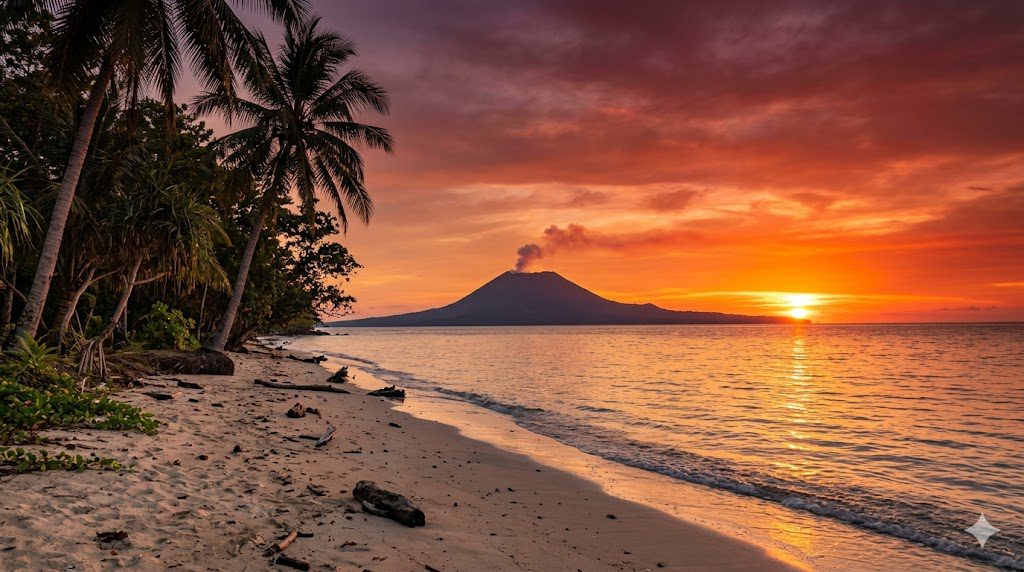
Stretching roughly 150 kilometers along the western edge of Java, the Banten coastline runs from Anyer in the north down to the remote village of Sumur in the south. It faces directly west toward the Sunda Strait, which means something that sounds simple—but is actually rare in Indonesia:
Uninterrupted sunsets over open ocean.
There are no mountains blocking the horizon. No cliffs cutting the view. Just sky, water, and light.
And on clear days, there’s something else.
In the distance, rising subtly from the sea, you’ll see the silhouette of Anak Krakatau—one of the most active volcanic islands in Indonesia. It doesn’t dominate the landscape. It doesn’t demand attention. But it’s there, quietly shaping the identity of the entire coastline.
At first glance, the Banten Coast might not seem like a major destination. It lacks the branding of Bali, the luxury of private islands, or the global recognition of Indonesia’s more famous spots.
But that’s exactly the point.
This is not a curated destination.
It’s a working coastline.
It’s local.
It’s inconsistent.
And that’s what makes it interesting.
Because here’s the reality:
Not all parts of the Banten Coast are worth your time.
Some areas are overcrowded, noisy, and heavily commercialized. Others are quiet, raw, and almost completely untouched.
The difference between those two experiences is not subtle.
And it comes down to one simple factor:
👉 How far you’re willing to drive.
This guide will help you navigate that difference—clearly, honestly, and without the usual travel clichés.
2. Where Is the Banten Coast? (Closest Beaches Near Jakarta Explained)
As one of the most talked-about West Java beaches, the Banten Coast provides a rare opportunity to experience Indonesia’s coastline without leaving the main island of Java, making it especially attractive for international travelers based in Jakarta.
The Banten Coast lies in Banten Province, the western most region of Java, Indonesia. Geographically, it sits along the Sunda Strait, directly facing the island of Sumatra.
For travelers searching for beaches near Jakarta, this is the closest true coastline you can reach without needing a plane or a boat.
That alone makes it unique.
Indonesia is an archipelago, and in most cases, reaching a beautiful beach involves at least one additional layer of travel—whether that’s a domestic flight, a ferry, or a boat transfer.
Banten removes all of that.
You stay on the same island. You stay on land. And yet, you still reach the ocean.
The coastline itself stretches from Anyer in the north to Sumur in the south, covering roughly 150 kilometers. But what matters more than the total distance is how dramatically the experience changes along that stretch.
Distance and Travel Time
- Anyer — 150 km (2.5–3 hours)
- Carita — 170 km (3–3.5 hours)
- Tanjung Lesung — 200 km (around 4 hours)
- Ciputih & Sumur — 240–260 km (4.5–5 hours)
On paper, the difference between three hours and five hours doesn’t look significant.
In reality, it’s everything.
The first few hours get you to beaches that are accessible, popular, and heavily used by local travelers from Jakarta.
The extra hours take you somewhere else entirely.
Less traffic.
Less development.
Fewer people.
And eventually—silence.
That progression is what defines the Banten Coast.
Route Explained — What the Journey Actually Feels Like
The route itself is straightforward:
Jakarta → Tangerang–Merak Toll Road → Exit at Serang or Cilegon → Continue south toward Pandeglang → Follow the coastal road
At the beginning, the drive feels easy.
The toll road is smooth, fast, and well-maintained. Traffic flows predictably, and the experience is similar to driving on any major highway near a large city.
Then you exit.
And everything changes.
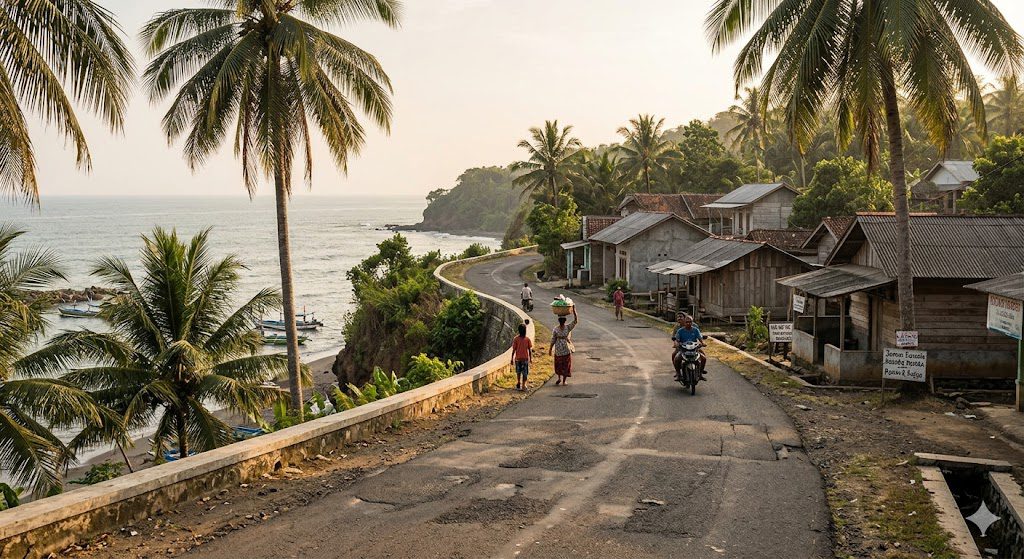
The wide toll lanes disappear, replaced by two-lane provincial roads. Traffic slows. Road quality becomes inconsistent. You’ll encounter potholes, uneven surfaces, and stretches without proper lighting.
You’ll also notice something else.
The environment shifts.
You pass through small towns, roadside food stalls, markets, and everyday life that you simply don’t see from an airplane window. Motorbikes carry entire families. Trucks move slowly through narrow roads. Directions become less obvious.
This part of the journey requires patience.
It’s not always comfortable.
It’s not always efficient.
But it’s real.
And then, eventually, the road opens up—and you reach the coast.
And in that moment, the entire journey makes sense.
3. Why Visit the Banten Coast?
For those planning a Jakarta beach getaway, the Banten Coast offers a combination of accessibility, natural scenery, and relatively low international tourism, making it a strong alternative to more crowded destinations.
Banten is not a destination built on perfection.
It doesn’t try to compete with Bali’s polish or Lombok’s rising luxury scene. It doesn’t offer seamless infrastructure or a curated experience.
What it offers instead is something far simpler—and, for many travelers, far more valuable.
1. Immediate Access from Jakarta
This is the biggest advantage, and it cannot be overstated.
From Jakarta, reaching most coastal destinations in Indonesia requires significant planning. Flights need to be booked, schedules coordinated, and buffers added for delays.
Banten removes all of that.
You land.
You drive.
You arrive.
For short trips or travelers passing through Jakarta, this is one of the most efficient ways to experience Indonesia’s coastline without losing an entire day to logistics.
2. A True West-Facing Coastline
Geography matters more than people think.
Most beaches in Indonesia do not face directly west. Many are partially blocked by cliffs, hills, or surrounding islands.
The Banten Coast is different.
It faces directly toward the open waters of the Sunda Strait.
That means every evening delivers the same core experience:
A clear horizon.
A wide sky.
And a sunset that unfolds without interruption.
On certain days, when visibility is high, Anak Krakatau appears in the distance—subtle but unmistakable.
It’s not dramatic in a loud, cinematic way.
It’s quieter than that.
And that’s exactly why it works.
3. A Gradual Shift from Crowded to Remote
One of the most interesting aspects of the Banten Coast is how it changes as you move along it.
It’s not a single destination—it’s a spectrum.
Near Jakarta, the beaches are busy, loud, and heavily used. These areas are built for convenience and accessibility.
As you drive further south, things begin to change.
Crowds thin out.
Development decreases.
The coastline starts to feel more open.
And if you keep going, you eventually reach areas where there are no crowds at all.
Just ocean.
Sand.
And space.
This progression allows you to choose your experience.
4. A More “Real” Travel Experience
Banten is not designed around international tourism.
English is limited.
Facilities vary.
Standards are inconsistent.
And that might sound like a drawback—but for many travelers, it’s the opposite.
Because what you get instead is authenticity.
You eat at local warungs.
You interact with local communities.
You experience a place that hasn’t been reshaped to meet global expectations.
It’s not always easy—but it’s real.
Is This a Hidden Gem?
Short answer: not entirely.
Long answer: it depends where you go.
Anyer → ❌ Not Hidden
Anyer is one of the most popular beach areas for Jakarta residents.
On weekends, it’s crowded, noisy, and heavily commercialized. Water sports dominate the shoreline, music plays loudly, and traffic can become a serious issue.
It’s accessible—but it’s not what most international travelers are looking for.
Carita → ⚖️ Semi-Known
Carita is calmer, but still active.
It offers a more relaxed environment, especially on weekdays, but it still attracts domestic tourists during holidays and weekends.
It’s a middle ground—not fully commercial, but not untouched.
Tanjung Lesung → ✅ The Sweet Spot
This is where things begin to shift.
Tanjung Lesung is more organized, cleaner, and quieter. It has better infrastructure, more controlled development, and a more relaxed atmosphere.
For many travelers, this is the ideal balance between comfort and authenticity.
Ciputih & Sumur → 💎 True Hidden Gems
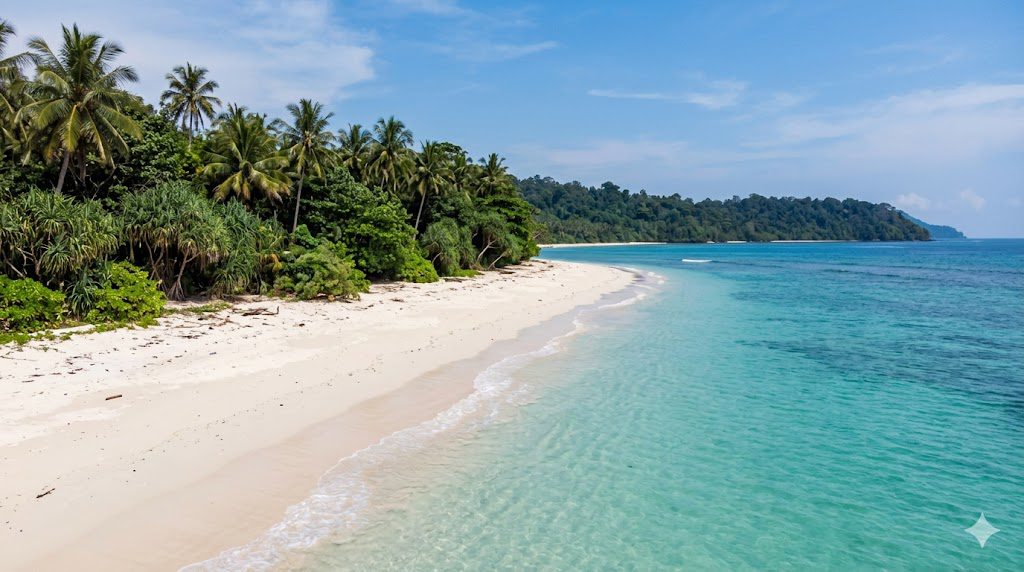
Beyond Tanjung Lesung, everything changes.
These areas are remote, quiet, and largely untouched.
Beaches are empty.
Facilities are minimal.
Tourism is almost nonexistent.
This is where the Banten Coast truly feels like a hidden gem—but it requires effort to get there.
In fact, some of the southern areas can easily be considered among the last remaining hidden beaches in Indonesia, where development is minimal and the experience feels largely untouched.
Verdict for International Travelers
Skip Anyer.
Use Carita only if necessary.
Go to Tanjung Lesung—or further.
That’s where the experience begins to align with what most travelers are actually looking for.
Transition
By now, one thing should be clear:
The Banten Coast is not difficult to understand—but it does require planning.
Distances may look short on paper, but road conditions and traffic can significantly affect your experience.
Get it wrong, and the trip becomes frustrating.
Get it right, and it becomes one of the easiest coastal escapes in Indonesia.
4. How to Get There (VERY IMPORTANT)
One of the reasons the Banten Coast is becoming more popular is because it’s one of the easiest weekend trips from Jakarta, requiring no flights, no ferries, and minimal planning compared to other beach destinations in Indonesia.
By Car — The Only Real Option
This is a road trip destination.
There is no practical alternative.
Rent a car in Jakarta and drive.
Driving Overview
- Toll road: smooth and fast
- After Serang: mixed conditions
Travel Time
- 2.5 hours → Anyer
- 3–3.5 hours → Carita
- 4 hours → Tanjung Lesung
- Up to 5 hours → Sumur
Costs
- Toll: $10–13 USD
- Car rental: $30–50/day
Alternatives
Train: possible but inconvenient
Flights: not available
👉 Conclusion: drive.
5. Best Time to Visit
Timing matters more than most people expect when visiting the Banten Coast.
Because this is not a heavily managed or controlled tourist destination, your experience will be directly affected by weather, sea conditions, and local travel patterns.
Dry Season (May – October) — The Best Time to Visit
If you want the Banten Coast at its best, this is when you should go.
During the dry season, you can expect:
- Clear skies and consistent sunlight
- Calmer sea conditions
- Better visibility toward Anak Krakatau
- More reliable sunsets
Temperatures typically range between 27–32°C (80–90°F), with humidity still present but manageable.
This is also when the coastline feels most “photogenic.” The water appears clearer, the horizon is more defined, and the overall atmosphere is more stable.
For international travelers with limited time, this is the safest window to plan your trip.
Rainy Season (November – April) — Still Possible, But Less Predictable
Travel during the rainy season is still possible—but expectations need to adjust.
You’ll likely experience:
- Sudden afternoon rain showers
- Rougher waves
- Cloud cover that may block sunset views
That said, mornings can still be clear, and resort stays—especially in Tanjung Lesung—remain enjoyable.
This period works better for travelers who prioritize relaxation over scenery.
When to Avoid Visiting
Some periods should be avoided entirely, regardless of weather:
- Idul Fitri (Eid) — The largest travel movement in Indonesia
- Long weekends and national holidays — Heavy traffic and overcrowding
- Christmas and New Year — Peak pricing and limited availability
During these times, roads can become severely congested, and beaches lose their appeal due to crowd density.
Pro Tip
If possible, plan your visit between Tuesday and Thursday.
Weekends are dominated by domestic tourism, and Mondays often show the aftermath—litter, traffic fatigue, and slower service.
6. Top Things to Do
The Banten Coast is not activity-heavy in the traditional sense.
There are no large-scale attractions, theme parks, or structured tourism circuits.
What you’ll find instead is something simpler—and for many, more rewarding.
Beach Time — The Core Experience
At its heart, Banten is about being near the ocean.
Swimming, relaxing, walking along the shore—these are the main activities.
However, conditions vary depending on location.
- Tanjung Lesung offers calmer waters and is generally safer
- Carita has mixed conditions—some areas are safe, others not
- Anyer often has stronger currents
- Ciputih is calm but lacks supervision
Always observe locals. If no one is swimming, there’s usually a reason.
Sunset Watching — The Highlight
This is the defining experience of the Banten Coast.
Because the entire coastline faces west, sunsets are not occasional—they’re guaranteed (weather permitting).
As evening approaches, the atmosphere changes.
The heat drops, the light softens, and people naturally move toward the shoreline.
Then, slowly, the sky shifts.
Orange, gold, and deep red tones reflect across the surface of the water. On clear days, Anak Krakatau appears in silhouette.
It’s not loud or dramatic.
It’s quiet.
And that’s what makes it memorable.
Exploring Less-Known Beaches
One of the best ways to experience Banten is simply to explore.
The coastal road connects dozens of unnamed or minimally developed beaches.
Some will be empty.
Some will be rough.
Some will surprise you.
Ciputih is the standout example—a stretch of white sand with almost no development.
But finding your own spot is part of the experience.
Water Activities
Water sports exist—but they vary by location.
- Anyer & Carita — Jet skis, banana boats, and family-oriented activities
- Tanjung Lesung — More controlled options like kayaking and paddleboarding
If you’re looking for high-end diving or snorkeling, this is not the destination.
But for casual water activities, it works.
7. Best Areas Breakdown (What Each Place Actually Feels Like)
Understanding the differences between areas is critical.
Because each location offers a completely different experience.
Anyer — Accessible but Overwhelming
Anyer is the closest beach area to Jakarta—and it shows.
It’s crowded, loud, and heavily commercialized, especially on weekends.
For first-time visitors expecting a quiet coastal escape, it can be disappointing.
Carita — The Middle Ground
Carita offers a more balanced experience.
It’s less chaotic than Anyer and has a slower pace, especially during weekdays.
However, it still receives significant domestic tourism.
Think of it as a transitional zone—not fully developed, but not remote.
Tanjung Lesung — The Best Base
This is where most international travelers should stay.
It’s cleaner, quieter, and more organized.
Resorts are better maintained, and the overall experience feels more controlled without being overly commercial.
Ciputih — Raw and Undeveloped
Ciputih is where the “hidden gem” label starts to make sense.
There are no crowds, minimal facilities, and very little structure.
This is for travelers who are comfortable with simplicity.
Sumur — The Edge of the Map
Sumur feels like the end of the road.
It’s a small fishing village with limited tourism infrastructure.
But it also serves as a gateway to Ujung Kulon National Park.
8. Where to Stay (Realistic Expectations)
Accommodation on the Banten Coast varies significantly.
If you’re wondering where to stay in Tanjung Lesung Indonesia, this area offers the best range of accommodation options along the Banten Coast, from luxury beachfront resorts to more affordable mid-range stays.
Luxury — Tanjung Lesung Only
If you’re looking for comfort, this is your only real option.
Resorts here offer:
- Private beaches
- Pools
- Better service
- English-speaking staff
This is the safest choice for international travelers.
Mid-Range — Carita & Surrounding Areas
Mid-range hotels offer decent comfort at a lower price.
However, quality varies.
Always check recent reviews before booking.
Budget — Everywhere (But Basic)
Budget stays exist across the region.
Expect:
- Minimal facilities
- Limited cleanliness
- Little to no English
This works for flexible travelers—but not everyone.
9. Food & Dining — What It’s Really Like
Food in Banten is simple, consistent, and heavily seafood-based.
This is not a destination for culinary diversity.
It’s a destination for freshness.
What You’ll Eat
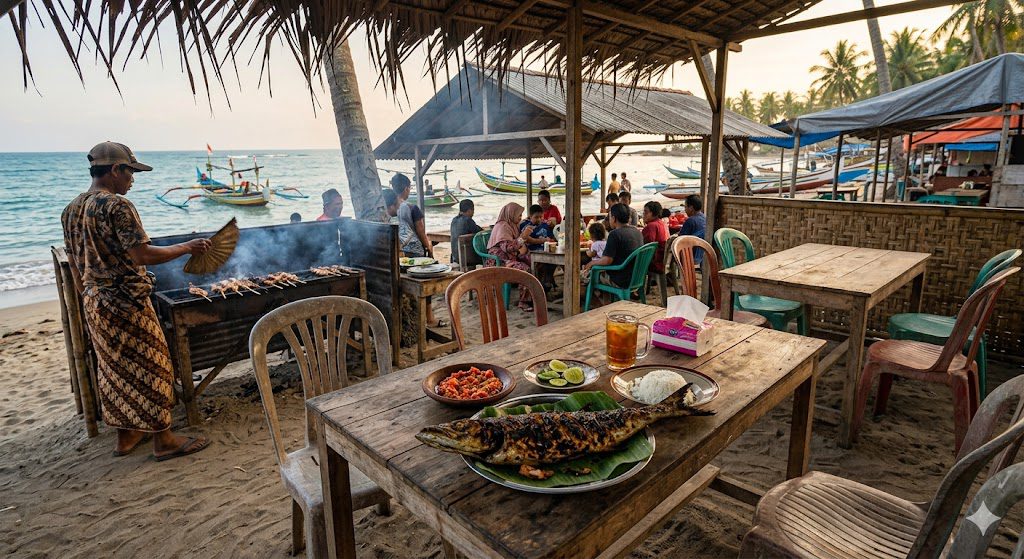
Most meals include:
- Grilled fish
- Rice
- Sambal
- Basic vegetables
And that’s the core experience.
Warung Experience
Eating at a local warung is one of the highlights.
You sit close to the ocean, often on plastic chairs, while your food is prepared over charcoal.
It’s not refined—but it’s authentic.
What to Be Careful About
- Spice levels can be intense
- Hygiene varies
- Always drink bottled water
If you’re sensitive, stick to resort dining for your first meals.
10. Travel Tips You Should Not Ignore
This is not a place where you can rely entirely on convenience.
Preparation matters.
Roads Are the Biggest Challenge
Outside the toll road:
- Narrow lanes
- Poor lighting
- Uneven surfaces
Avoid driving at night.
Cash Is Essential
Card payments are limited.
Always carry cash—especially outside main areas.
Ocean Safety
The Sunda Strait can be unpredictable.
Strong currents exist.
👉 If locals aren’t swimming, you shouldn’t either.
Weekends Change Everything
Weekdays = calm
Weekends = crowded
Plan accordingly.
11. Sample Itinerary (3 Days / 2 Nights)
If you’re visiting the Banten Coast for the first time, this is one of the most realistic and efficient ways to structure your trip.
This itinerary balances travel time, comfort, and exploration—without rushing the experience.
Day 1 — Jakarta → Carita
Start early from Jakarta to avoid traffic.
- 08:00 — Pick up rental car and depart Jakarta
- 11:00 — Arrive in Anyer (short stop only)
- 13:00 — Continue to Carita
- 14:00 — Check-in and relax
- 17:30 — Sunset by the beach
- 19:00 — Seafood dinner at a local warung
Day 2 — Carita → Tanjung Lesung
- 08:00 — Breakfast
- 09:00 — Drive to Tanjung Lesung (approx. 1.5 hours)
- 11:00 — Beach time / snorkeling / kayaking
- 13:00 — Lunch at resort
- 15:00 — Relax or explore surrounding beaches
- 17:30 — Sunset at Tanjung Lesung (best viewpoint)
- 19:00 — Dinner
Day 3 — Optional Ciputih → Return to Jakarta
If you want to experience a more remote side of the Banten Coast, wake up early and head further south.
- 07:00 — Drive to Ciputih (approx. 1 hour)
- 08:30 — Explore empty white sand beach
- 10:30 — Begin return journey to Jakarta
- 15:00 — Arrive in Jakarta
Alternative: Skip Ciputih and enjoy a slower morning in Tanjung Lesung before heading back.
12. Final Verdict — Is the Banten Coast Worth Visiting?
For many travelers, the question is simple: is the Banten Coast worth visiting?
The answer depends on expectations.
This is not Bali. It’s not a polished, international-level destination with perfect beaches and seamless infrastructure.
But that’s also its strength.
What the Banten Coast offers is something different:
- Accessibility from Jakarta
- West-facing sunset views
- A mix of developed and untouched coastline
- A more local and less commercialized experience
Best for:
- Short trips (2–4 days)
- Road trip travelers
- Exploring beyond Bali
- Seeing a different side of Indonesia
Not ideal for:
- Luxury-only travelers (outside Tanjung Lesung)
- Those expecting perfectly clean beaches everywhere
- Travelers without a car
Ultimately, the Banten Coast is not about perfection.
It’s about proximity, simplicity, and discovery.
And if you’re willing to drive just a little further than most people, you’ll find that it still holds pockets of coastline that feel surprisingly untouched.
Final Thoughts
The Banten Coast may not have the global reputation of Bali, but for travelers looking for the best beaches near Jakarta for foreigners, it offers one of the most practical and rewarding coastal experiences in Indonesia.
With a mix of accessible beach towns, emerging resort areas, and truly remote coastline, it provides a level of variety that few destinations this close to a major city can match.
If you’re willing to explore beyond the obvious, the Banten Coast can easily become one of the most memorable parts of your trip to Indonesia.